Messier Photo Marathon (poster & video)
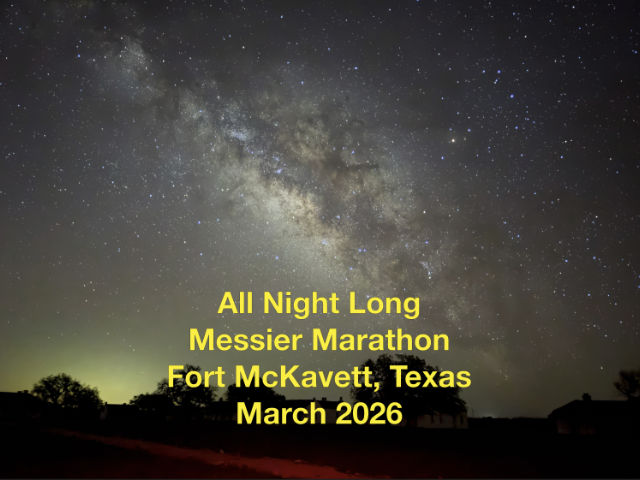
A Messier Marathon, viewing or imaging all 110 objects in the catalog, is possible only a couple of weeks during the year. Mid to late March usually the best. Success requires near ideal weather and location. Those came together March 19-22 at the Fort McKavett State Historic Site in an event organized by the San Antonio Astronomical Association with participants from many Texas clubs.
This poster captures all 110 Messier deep sky objects in the order observed. The linked full resolution version can be printed at 300dpi, 30"x20". All my photography is Creative Commons, Attribution-NonCommercial-ShareAlike 4.0 International, licensed.
With about 9 1/4 hours of darkness available in central Texas, this gives 555 minutes to observe 110 objects or about 5 minutes to locate and observe each. Even a skilled visual observer, without a goto telescope mount, will spend most of his time finding targets with only a brief glimpse of each. A goto mount speeds up object location giving more time for observation. A live view stacking camera setup allows even more detailed views of the objects. Each light frame can be saved for improved stacking and processing after the even capturing a permanent record of each observation. I opted for this latter approach as the best match for my skills and interests. My goal is to produce a poster matrix of the images, but after initially processing the images, I realized that a video would be another way to capature the event.
This “All Night Long” video captures my 9 1/4 hours of observing 110 objects the night of the 19th compressed into 8 minutes.
The average total integration time for each image is about 5 minutes. Minimum was 3 minutes and maximum 18 minutes. Where did the extra time come from? I used a W.O. RedCat 250/51 mm telescope with an ASI2600 MC camera giving me a field of view of 5.38x3.6 degrees. Careful selection of targets allows multiple targets to be imaged in some shots. This allows extra time for dimmer targets that would most benefit from extra integration time as well as the occasional nature break.
Using live view mode with the ASIAIR had two advantages. I could enjoy watching images improve with each exposure and make on the fly decisions on total integration time. In this mode the ASIAIR also stored each light frame organized by target name, simplifying subsequent processing. Processing 110 images is a daunting task. I used a simplified workflow in PixInsight using Weighted Batch Pre Processing, automatic Dynamic Background Extraction, deconvolution with BlurXTerminator, and noise reduction with NoiseXTerminator. With such short exposure, high quality images are out of reach, but the results were largely pleasing and achieved within a week!
Content created: 2026-03-29 and last modified: 2026-04-02

Comments
 Submit comments or questions about this page.
By submitting a comment, you agree that: it may be included here in whole or part, attributed to you, and its content is subject to the site wide Creative Commons licensing.


 July-September
Made with care using XML on a Mac in Austin, Texas on
2026-08-24
© 2026 Robert C. Pettengill,
Ph.D. 